

Papers in the Biological Sciences
Papers in Behavior in Biological Sciences
Accessibility Remediation
If you are unable to use this item in its current form due to accessibility barriers, you may request remediation through our remediation request form.
Document Type
Article
Date of this Version
2001
Abstract
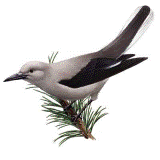
Two groups of Clark's nutcrackers were trained to find buried seeds whose location was defined by a constant angle from two landmarks whose interlandmark distance and position in the room varied across trials. The first group had a landmark array that was always placed in the same orientation with respect to the walls, allowing the animals to use both relative and absolute bearings. The second group had a landmark array that rotated across trials so that only relative bearings could be used to locate the seeds. The birds in each group learned the task and transferred to new interlandmark distances both within and beyond the range of training distances. Results from these experiments indicate that nutcrackers can learn a geometric relationship that relies exclusively on relative bearings even though the use of absolute bearing yields more efficient search.
Comments
Published in Animal Learning & Behavior 2001.29 (2).120-132.