

Papers in the Biological Sciences
Papers in Behavior in Biological Sciences
Accessibility Remediation
If you are unable to use this item in its current form due to accessibility barriers, you may request remediation through our remediation request form.
Document Type
Article
Date of this Version
2001
Abstract
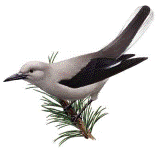
Clark’s nutcrackers (Nucifraga columbiana) are capable of very precise searching using the metric relationships between a goal and multiple landmarks to relocate the goal location. They can judge the direction more accurately than the distance to a landmark when the landmark is distant from the goal. On the basis of these findings, we propose that nutcrackers use a set of bearings, each a measure of the direction from the goal to a different landmark, when searching for that goal. The results of a simulation demonstrate that increasing the number of landmarks used results in increasingly precise searching. This multiple-bearings hypothesis makes a series of detailed predictions about how the distribution of searches will vary as a function of the geometry of the locations of the relevant landmarks and the goal. It also suggests an explanation for inconsistencies in the literature on the effects of clock-shifts on searching and on homing.
Comments
Published in The Journal of Experimental Biology 2043, 103–113 (2001) Printed in Great Britain © The Company of Biologists Limited 2001. Used by permission.