

Papers in the Biological Sciences
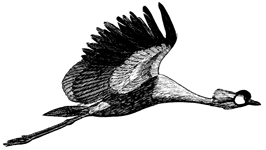
Cranes of the World by Paul A. Johnsgard
Accessibility Remediation
If you are unable to use this item in its current form due to accessibility barriers, you may request remediation through our remediation request form.
Date of this Version
January 1983
Document Type
Book Chapter
Abstract
Other Vernacular Names:
Siberian white crane, Asiatic White Crane; Grue nonne, Grue blanche d'Asie (French); Nonnenkranich, Schnee-Kranich, Weisse indische Kranich (German); Sod egura-zuru (Japanese); Sterch, Belyi zhuravl (Russian); Grulla siberiana, Grulla blanco (Spanish).
Range:
Known breeding areas are currently only two. The first is from about the confluence of the Ob and Irtysh rivers north to the region of Berezovo, and the second is from the basin of the Indigirka (from its mouth south to the Moma River) west to the Khroma River and the lower Yana. Other possible breeding areas may extend the second range east to the lower Kolyma and west to the region east of the lower Lena River. Possibly breeding also occurs or once occurred in the valley of the lower Vilyuy and on the Vitim Plateau and, in the west, the swamps north of the Baraba steppe. Breeding was formerly much more extensive, and included the Kirghiz and Siberian steppes, and per haps from southeastern Transbaikalia to northern Morlgolia and northern Manchuria (Vaurie, 1965). Wintering occurs (rarely) in the south Caspian (Iran), and in the Keoladeo Ghana Sanctuar y, near Bharatpur, Rajasthan, India. The east Siberian breeding population winters in the Yangtze Basin of eastern China, in the swampy parts of northern Jiangxi Province (Tso-hsin Cheng, in lit.).
Comments
From Cranes of the World by Paul A. Johnsgard (Bloomington, IN: Indiana University Press, 1983; electronic edition: Lincoln, NE, 2008). Copyright © 1983 Paul A. Johnsgard.