

Papers in the Biological Sciences
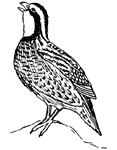
Grouse and Quails of North America by Paul A. Johnsgard
Accessibility Remediation
If you are unable to use this item in its current form due to accessibility barriers, you may request remediation through our remediation request form.
Date of this Version
May 2008
Document Type
Book Chapter
Abstract
There can be little doubt that the grouse and quail provide the most important and most popular targets for more than ten million small-game hunters every year in North America (National survey, 1965). In much of the southeast, to go "bird" hunting simply means a day in pursuit of bobwhites, and likewise in New England "pa'tridge" hunting is regarded as the premier sport of all upland game hunting. These two species, the bobwhite and ruffed grouse, in 1970 were hunted in forty-seven states and eight provinces and are without question the most important of all North American upland game species (table 27). Although neither species was hunted during 1970 in Arizona or South Dakota, both have been legal game in South Dakota in recent years, and masked bobwhites originally occurred in southern Arizona, where they are now being restocked. In addition, the bobwhite occurs over much of Mexico and is an important game species in that country.
In table 27 is presented a list of the grouse and quail occurring north of Mexico, as well as the states and provinces in which they could legally be hunted during the 1970–71 hunting season, based on information available to the author. Of course, the length of the season and the daily limits varied greatly in different areas and in a few instances the total season lasted only a day or two. However, the list does provide a method of estimating the relative importance of the species as game. On this basis alone, the ruffed grouse might be judged most important, while the bobwhite is almost as widely hunted. Other species that are currently hunted in ten or more states and provinces are the sage grouse, blue grouse, spruce grouse, sharp-tailed grouse, chukar partridge, and gray partridge.
Comments
From Grouse and Quails of North America, by Paul A. Johnsgard (Lincoln, NE, 1973 & 2008). Electronic edition copyright © 2008 Paul A. Johnsgard.