

Papers in the Biological Sciences
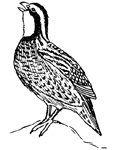
Grouse and Quails of North America by Paul A. Johnsgard
Accessibility Remediation
If you are unable to use this item in its current form due to accessibility barriers, you may request remediation through our remediation request form.
Date of this Version
May 2008
Document Type
Book Chapter
Abstract
The modern array of grouse-, quail-, and partridge-like species occurring in North America is the result of three processes: evolution and speciation within this continent, range expansion or immigration from Central America and Eurasia, and recent introductions by man. The last category accounts for the presence in North America of the chukar and gray partridges, which are both natives of Europe or southern Asia and typical representatives of the quail-like and partridge-like forms that have extensively colonized those land masses. It is still necessary to account for the presence of the nine or so species of grouse-like forms that are native to this continent, as well as the fourteen or fifteen species of New World quails that occur north of the Guatemala-Mexico border. In general, the evidence clearly indicates that the New World quails had their center of evolutionary history and speciation in tropical America, whereas the grouse are a strictly Northern Hemisphere group that perhaps originated in North America but which now occur throughout both this continent and Eurasia and at present represent about an equal number of species in each of the two hemispheres. North America therefore has provided the common ecological conditions to which two distinctly different groups of gallinaceous birds have become independently adapted and have undergone somewhat convergent evolutionary trends.
The evolutionary history of grouse- and quail-like birds on this continent is a long one, going back to at least Oligocene times, from which an indeterminate quail-like fossil is known, an addition to a unique fossil quail genus (Nanortyx) (Tordoff, 1951). Perhaps Paleophasianus from the Eocene represents the earliest grouse-like fossil (Holman, 1961), although it is more probably a species of limpkin (Cracraft, 1968).
Comments
From Grouse and Quails of North America, by Paul A. Johnsgard (Lincoln, NE, 1973 & 2008). Electronic edition copyright © 2008 Paul A. Johnsgard.