

Papers in the Biological Sciences
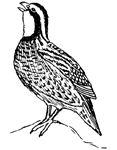
Grouse and Quails of North America by Paul A. Johnsgard
Accessibility Remediation
If you are unable to use this item in its current form due to accessibility barriers, you may request remediation through our remediation request form.
Date of this Version
May 2008
Document Type
Book Chapter
Abstract
An understanding of the molts and plumages of the quails and grouse is of great importance to the applied biologist, for they provide clues that are valuable for determining age and sex of individual birds without resorting to internal examination. They thus offer a means of analyzing wild populations as to sex and age composition, which are basic indices to past and potential reproductive performances and probable mortality rates. Additionally, molts and plumages are generally speciesspecific traits, which have resulted from pressures of natural selection over a long period of time in a particular habitat and climate. The ecology of the species is of major importance in this regard; species occurring in more northerly regions may undergo their molts more rapidly than those in southerly ones or, as in the case of the willow ptarmigan, certain races may even lack particular plumages that occur in populations existing in other areas having different climates.
From the time they hatch, all grouse and quails exhibit a series of specific plumages, separated by equally definite molts, that are comparable in nearly all species. The only known exception to this occurs in the genus Lagopus, which is unique in having an extra molt, and thus a supplementary plumage, intercalated between its summer and winter plumages. This special case will be dealt with as required; the following summary will thus serve to provide the basic sequences and terminology that describe the molts and plumages found in the North American grouse and quails.
Comments
From Grouse and Quails of North America, by Paul A. Johnsgard (Lincoln, NE, 1973 & 2008). Electronic edition copyright © 2008 Paul A. Johnsgard.