

Papers in the Biological Sciences
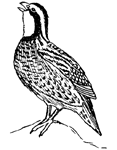
Grouse and Quails of North America by Paul A. Johnsgard
Accessibility Remediation
If you are unable to use this item in its current form due to accessibility barriers, you may request remediation through our remediation request form.
Date of this Version
May 2008
Document Type
Book Chapter
Abstract
The study of hybridization between species, under either natural or artificial conditions, provides information of value for a variety of reasons. In general, it may be expected that the incidence of crossbreeding between populations existing under natural conditions will be related to their nearness of relationship, and information of taxonomic interest may be obtained from such study. Furthermore, the relative survival and fertility of the resulting hybrids should provide an indication of the degree of genetic difference between the parental types, and thus genetic information may be available through experimental hybridization studies. Hybrids provide favorable material for studying the chromosomal numbers and configurations among related species, and when they are fertile the degree of phenotypic variation in second or backcross generations may be used to estimate genetic differences controlling specific traits. Finally, the presence or absence of natural hybridization between closely related forms occurring in the same habitats may provide a clue as to the degree of niche overlap and interspecies competition for habitat resources. Therefore, if the basis for periodic or local hybridization between two forms that normally do not hybridize can be established, the ecological differences that normally prevent hybridization may possibly be deduced.
For various reasons, the grouse and quails of North America exhibit a rather surprisingly high tendency to hybridize, even among species belonging to seemingly different genera. Peterle (1951) reviewed the cases of intergeneric hybrids reported in gallinaceous birds, and Cockrum (1952) provided a more complete survey of hybridization in North American birds. Sibley (1957) commented on the taxonomic significance of hybridization in grouse, and a similar review of the significance of hybridization in the New World quails is available (Johnsgard, 1970). For a complete listing of all known hybrids of gallinaceous birds, including those reported from Europe and Asia, the summary by Gray (1958) may be consulted.
Comments
From Grouse and Quails of North America, by Paul A. Johnsgard (Lincoln, NE, 1973 & 2008). Electronic edition copyright © 2008 Paul A. Johnsgard.