

Instructional Materials in Physics and Astronomy
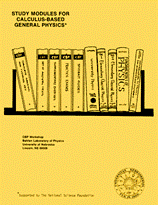
Calculus-Based General Physics
Accessibility Remediation
If you are unable to use this item in its current form due to accessibility barriers, you may request remediation through our remediation request form.
Date of this Version
1975
Document Type
Article
Abstract
When a body is at rest, we know from experience that it will remain at rest unless something is done to change that state. A heavy box on the floor will stay in place unless it is pushed or pulled. We walk without fear beside a massive rock on level ground because we know it won't suddenly move and crush us.
Undoubtedly you have leaned against a chair only to have it move and send you scurrying for your balance. Did you then question the relationship of the interaction between you and the chair to the ensuing motion of the chair?
It was Isaac Newton who first clearly made the connection between the interactions on a body and its motion. In Newton's theory, the acceleration of every object has to be explained in terms of the interactions with other objects. Newton's laws of motion cover an enormous range of experience. At one stroke they convert what in retrospect had previously seemed chaos into a beautifully organized universe. There have been few achievements to rank with this in the history of science.
Comments
From Study Modules for Calculus-Based General Physics
Copyright © 1975 CBP Workshop, University of Nebraska–Lincoln.
Reproduction rights granted.