

Department of Physics and Astronomy: Publications and Other Research
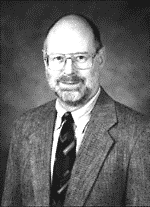
Robert G. Fuller Publications
Document Type
Article
Date of this Version
2-1-1977
Abstract
The life of every physicist is punctuated by events that lead him to discover that the way physicists see natural phenomena is different from the way non-physicists see them. Certain patterns of reasoning appear to be more common among physicists than in other groups. These include:
• focusing on the important variables (such as the force that accelerates the apple, rather than the lump it makes on your head);
• propositional logic ("if heat were a liquid it would occupy space and a cannon barrel could only contain a limited amount of heat, but this is contrary to my observations, so . . ."), and
• proportional reasoning (for example, the restoring force of a spring increases linearly with its displacement from equilibrium).
In recent studies of the reasoning used by students we have discovered among them qualitative differences similar to those between the reasoning patterns of physicists and non-physicists.
Comments
Published in PHYSICS TODAY / FEBRUARY 1977. Copyright 1977. Used by permission.