

Department of Physics and Astronomy: Individual Faculty Pages
Robert Katz Publications
Accessibility Remediation
If you are unable to use this item in its current form due to accessibility barriers, you may request remediation through our remediation request form.
Document Type
Article
Date of this Version
June 1993
Abstract
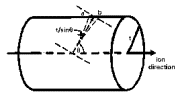
Data for the inactivation of three Escherichia coli mutants by energetic heavy ions are fitted by the track theory of a one-hit detector in an extended target mode. The respective E0’s are 46, 36.5, and 12.6 Gy for E. coli B, B/r, and Bs-1, and a0, the assumed target radius, is 0.5 μm for all three. The parameter E0, the D37 with γ rays, is measured directly, while a0 is fitted to the data. It is significant that neither a point target model nor calculations with a0= 0.2 and 1.0 μm fit the data. Our fitted target radius, a0, approximates the size of the bacterium. These results raise questions as to why the E. coli mutants are one-hit detectors, and concerning the differences in the E0’s in relation to a mechanistic interpretation of cell killing.
Comments
Published in Radiation Research 134:3 (June 1993), pp. 261–264 Published by the Radiation Research Society; copyright © 1993 by Academic Press, Inc. Used by permission.