

Wildlife Disease and Zoonotics
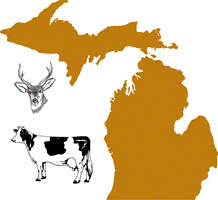
Michigan Bovine Tuberculosis Bibliography and Database
Accessibility Remediation
If you are unable to use this item in its current form due to accessibility barriers, you may request remediation through our remediation request form.
Date of this Version
3-2004
Abstract
Tuberculosis is a term that encompasses various diseases caused by bacteria of the Mycobacterium tuberculosis complex, including M tuberculosis, M bovis, M africanum, and other mycobacterial species. Whereas M tuberculosis infection is largely spread from human to human, M bovis infection has been identified as a zoonotic disease with most cases of human infection attributable to animal sources. The mycobacteria other than tuberculosis complex (MOTT), which includes M avium subsp avium and M avium subsp intracellulare isolated from animals, has been isolated from immune-compromised humans (ie, those with human immunodeficiency virus [HIV] infection), but seldom from immunocompetent humans. Recently, there has been increased interest among public health officials in drug-resistant strains of M tuberculosis, M bovis, and M avium because several have been isolated from HIV-infected and nonimmuno-compromised humans.
Comments
Published in JAVMA, Vol 224, No. 5, March 1, 2004.