

Plant Pathology, Department of
Department of Plant Pathology: Faculty Publications
Accessibility Remediation
If you are unable to use this item in its current form due to accessibility barriers, you may request remediation through our remediation request form.
Document Type
Article
Date of this Version
2011
Citation
Virology 410 (2011) 268–281.
Abstract
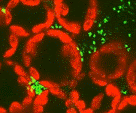
A series of Wheat streak mosaic virus (WSMV)-based expression vectors were developed by engineering a cycle 3 GFP (GFP) cistron between P1 and HC-Pro cistrons with several catalytic/cleavage peptides at the Cterminus of GFP. WSMV-GFP vectors with the Foot-and-mouth disease virus 1D/2A or 2A catalytic peptides cleaved GFP from HC-Pro but expressed GFP inefficiently. WSMV-GFP vectors with homologous NIa-Pro heptapeptide cleavage sites did not release GFP from HC-Pro, but efficiently expressed GFP as dense fluorescent aggregates. However, insertion of one or two spacer amino acids on either side of NIb/CP heptapeptide cleavage site or deletion in HC-Pro cistron improved processing by NIa-Pro. WSMV-GFP vectors were remarkably stable in wheat for seven serial passages and for 120 days postinoculation. Mite transmission efficiencies of WSMV-GFP vectors correlated with the amount of free GFP produced. WSMVGFP vectors infected the same range of cereal hosts as wild-type virus, and GFP fluorescence was detected in most wheat tissues.
Comments
U.S. government work.