

Biochemistry, Department of
Vadim Gladyshev Publications
Accessibility Remediation
If you are unable to use this item in its current form due to accessibility barriers, you may request remediation through our remediation request form.
Document Type
Article
Date of this Version
May 2003
Abstract
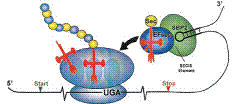
In the genetic code, UGA serves as a stop signal and a selenocysteine codon, but no computational methods for identifying its coding function are available. Consequently, most selenoprotein genes are misannotated. We identified selenoprotein genes in sequenced mammalian genomes by methods that rely on identification of selenocysteine insertion RNA structures, the coding potential of UGA codons, and the presence of cysteine-containing homologs. The human selenoproteome consists of 25 selenoproteins.
COinS
Comments
Published in Science, vol. 300, no. 5624 (May 30, 2003), pp. 1439– 1443. Used by permission.