









-

Secure Software Engineering OER Initiative
Hamid Bagheri and David Hemsath
The Secure Software Engineering OER Initiative was designed to create open educational resources for CSCE 469/869: Secure Software Engineering in order to reduce student costs, replace aging textbook-dependent materials, and improve access to high-quality, current course content.
The project produced a comprehensive set of OER materials for CSCE 469/869: Secure Software Engineering. These materials include a full slide deck series, detailed notes to teacher for each class session, and a revised course syllabus aligned to the OER-based course structure. The slide materials cover secure software principles, threat modeling, cryptography, security analysis methods, and platform security, and they are designed to support both classroom teaching and reuse by other instructors. Supporting instructional materials include course-aligned assignments, quizzes, project guidance, and accessible learning content developed to accompany the slides and syllabus.
-

Coordinated Linear Algebra
Anna Davis, Paul Zachlin, Allan P. Donsig, Levi Heath, and Mikkel Munkholm
This text is based on Anna Davis’s and Paul Zachlin’s Linear Algebra: An Interactive Introduction, which is freely available at https://sites.google.com/view/lin-alg-interactive-intro/ .
-

Concepts in Animal Parasitology (2026 Pressbooks version)
Scott L. Gardner and Sue Ann Gardner
This is a textbook covering concepts in animal parasitology. It is meant to be used by students, teachers, professors, researchers, and members of the public who are interested in learning about animal parasite biology, systematics, taxonomy, zoogeography, and ecology. The primary intended audience is upper-level undergraduate or graduate university students who have knowledge of basic biology and, particularly, basic animal biology.
Note that this 2026 Pressbooks version supercedes the 2024 version that is available as a Zea Book in the UNL Digital Commons (the whole book and the separate chapters) and at lulu.com.
-

Equality Before the Law: An Open Educational Resource
Kaci Nash
This Open Educational Resource (OER) features original documents and teaching materials from unpublished and unfamiliar legal cases, stories, and histories that have legacies in the U.S. today. Our aim is to help teachers, students, researchers, communities, and descendants piece together how law shaped U.S. history and the course of race, equality, freedom, and unfreedom from the colonial period to the present. Freely available for teaching and learning, the OER foregrounds the actions of ordinary Americans in the law.
-
Mapping the World: An Open Textbook on GIS and Remote Sensing
Ran Wang, Xiaomeng Li, and Andrew Husa
The global geospatial solutions market was valued at USD 626 billion in 2024; with a 13% projected annual growth rate, it is expected to reach $2155 billion by 2034 (Prescient and Strategic Intelligence, 2024). Globally, many governments are funding the development of geospatial infrastructure and promoting the geospatial solutions. A large number of students trained in geospatial sciences will be needed to support the steady demand for the workforce.
Geospatial science is a true interdisciplinary subject that covers a broad range of topics in both natural and social sciences and technologies. Usually, it is difficult to find one suitable textbook to cover all the materials in Geographical information system (GIS), global navigation satellite system (GNSS), remote sensing, and their broad applications. Requiring multiple textbooks will further increase the cost of taking these classes on students.
To address this challenge, we developed this Open Educational Resource (OER) by forming a team with distinct backgrounds spanning remote sensing, urban geography, historical geography, and sustainability in urban and rural areas. Our goal is to develop OER that can be used in introductory and intermediate levels geospatial science courses, covering concepts of GIS and remote sensing and their applications in a wide range of disciplines.
-

Coordinated Multivariable Calculus
Steve Schlicker, Mitchel Keller, Nicholas Long, Zach Norwood, and Audrey Goodnight
Coordinated Multivariable Calculus is adapted from Active Calculus: Multivariable + Vector by Steve Schlicker, Mitchel T. Keller, and Nicholas Long, originally released under a Creative Commons license. Much of the spirit of the original text is preserved, though we have added many worked examples and simplified some of the presentation. We have also trimmed the material to match the material of Math 208 at UNL; mostly we have moved the extra material to Extra Topic sections at the end of chapters, but in some cases we have eliminated the material entirely to avoid confusion to students.
-

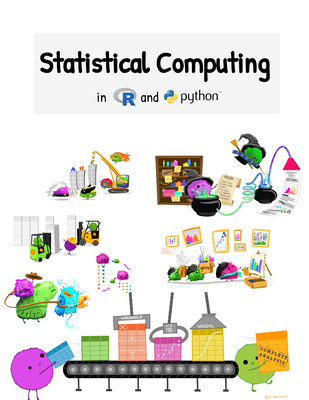
Statistical Computing Using R and Python
Susan VanderPlas
This book is designed to explain and demonstrate statistical programming concepts and techniques. I started this project in Summer 2020 as a less-tedious way to learn programming compared to hours and hours of video lectures. I’ve always found that watching someone code and talk about code is not usually the best way to learn how to code. It’s far better to learn how to code by … coding, but it’s hard to start from nothing, too.
Because this book was begun as an alternative to recorded lectures with slides, I have included all of the comics, snark, and gifs that I would normally have put in lecture slides. I’ve also supplemented this with other things that you can’t usually put in slide presentations: YouTube videos, extra resources, links to other textbooks that are more specific than this one. My goal is to make this a collection of the best information I can find on data science and statistical programming.
There is a downside to this approach: in most cases, this book includes way more information than you need. Everyone starts with a different level of computing experience, so I’ve attempted to make this book comprehensive. Unfortunately, that means some sections will seem like they are stating the obvious, and some sections will have more detail than you ever wanted to know. Use this book in the way that works best for you - skip over the stuff you know already, ignore the stuff that seems too complex until you understand the basics. Come back to the scary stuff later and see if it makes more sense to you.
-

Applied Calculus
Kevin Gonzales, Eric Hopkins, Catherine Zimmitti, and Cheryl Kane
This text may be used as a stand-alone textbook for a standard first year brief calculus course focusing on economic and business applications without requiring knowledge of trigonometry.
-
Contemporary Mathematics: Contemporary Mathematics at Nebraska
Michelle Homp, Alyssa Seideman, Sean Gravelle, and Andrew Hayes
MATH 203 Contemporary Mathematics is designed for students who are not majoring in mathematics and is intended to serve as a general education math class. The standard high school progression of algebra - geometry - more algebra - precalculus - calculus can leave many students with a distaste for math, partly because it gives the impression that mathematics is all about algebraic manipulations, and partly because it omits many areas of interesting mathematics needed for personal use or informed citizenship. MATH 203 tries to fill those gaps by covering a wide range of mathematical topics, of which algebra is only a small piece. The mathematical content that we hope students will find both interesting and useful has been divided into four units: statistics, social choice (such as voting theory and fair division), growth and finance, and graph theory. The text is intended to be supplemented for the Math 203 Course Manual available for purchase at the UNL Bookstore.
-

Coordinated Calculus
Nathan Wakefield, Christine A. Kelley, Marla Williams, Michelle Haver, Lawrence Seminario-Romero, Robert Huben, Aurora Marks, and Stephanie Prahl
This text may be used as a stand-alone textbook for a standard first year college calculus sequence.
-

Mathematics: PreCalculus Mathematics at Nebraska
Josh Brummer, Taran Funk, Ariel Setniker, Karina Uhing, Nathan Wakefield, and Catherine Zimmitti
Mathematics, as we all know, is the language of science, and fluency in algebraic skills has always been necessary for anyone aspiring to disciplines based on calculus. But in the information age, increasingly sophisticated mathematical methods are used in all fields of knowledge, from archaeology to zoology. Consequently, there is a new focus on the courses before calculus. The availability of calculators and computers allows students to tackle complex problems involving real data, but requires more attention to analysis and interpretation of results. All students, not just those headed for science and engineering, should develop a mathematical viewpoint, including critical thinking, problem-solving strategies, and estimation, in addition to computational skills. Modeling, Functions and Graphs employs a variety of applications to motivate mathematical thinking.
-
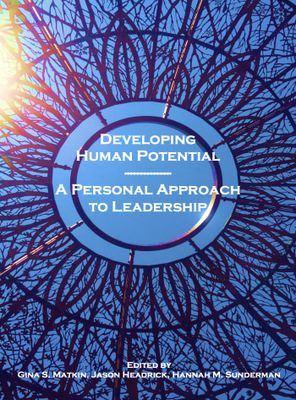
Developing Human Potential: A Personal Approach to Leadership
Gina S. Matkin, Jason Headrick, and Hannah Sunderman
This Online Educational Resource textbook is intended to provide an overview and introduction of leadership through the lens of how students can develop and maximize their own interpersonal skills. Interpersonal skills are crucial to navigating the professional world and can help us to better understand ourselves. This textbook approaches interpersonal skills from a personal level and allows the reader to immerse themselves into activities and scholarship across topical areas. Through the text, learners can create their own Personal Leadership Philosophy and expand this into a Civic Leadership Philosophy to help them understand the impact leaders can have on their communities and workplaces. This text is freely available per the terms of the Creative Commons copyright.
Online E-PUB & PDF https://pressbooks.nebraska.edu/developinghumanpotential/
-

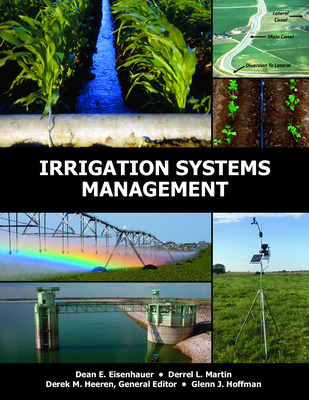
Irrigation Systems Management
Dean E. Eisenhauer, Derrel L. Martin, Derek M. Heeren, and Glenn J. Hoffman
Like most textbooks, this book grew out of our desire to have written material that matches the educational needs of both the students and the instructor of a college course, in this case a course entitled Irrigation Systems Management. The book is the culmination of course notes which have been in development and use for nearly 30 years.
The emphasis of this book is on the management of irrigation systems that are used for agricultural crop production. There are two distinct components of the book, starting with the soil-water-plant-atmosphere system and how soil water should be managed to achieve the desired crop production outcomes. This includes in-depth presentations on soil water storage and movement, plant water use, managing the soil water reservoir through irrigation scheduling, and salinity management. The book then shifts to the second component, which is the description and management of the various forms of agricultural irrigation systems along with their water supply. Whether it be a surface, sprinkler, or microirrigation system, the irrigation manager must not only know how much water to apply but also how to manage the system itself to achieve efficient application. High application efficiency can only be realized by minimizing runoff, deep percolation, evaporation, and drift onto non-target areas. Since energy costs are an integral part of the management equation, one chapter in the book deals with the hydraulics and energy requirements of pumping and distributing water. One of the key themes spread throughout the book is providing guidance to irrigation managers on how to improve irrigation water productivity (production per unit of irrigation water) and minimize water resource contamination.
Our goal is for the reader to understand the complexities of irrigation systems and how they are to be managed to meet the water needs of the crop production system. This is not an irrigation engineering design book; we have purposely minimized the presentation of design steps and the supporting equations. The intended audience of the book is upper-level undergraduate students and graduate students who are pursuing degrees in Agricultural or Natural Resource Sciences. Example majors include Agricultural Systems Technology, Agronomy, Crop Science, Mechanized Systems Management (or equivalent), Natural Resources Management, Soil Science, and Water Science. We expect the reader to have a basic understanding of soils, crops, physics, and the application of algebraic equations. We have also tried to add enough advanced material to challenge graduate students when the book is used in courses that are taught simultaneously at the undergraduate and graduate level. We hope the book will match the needs of students who plan to work in irrigation and related industries, university extension and outreach, private consulting, government service, or production agriculture and that it will continue to serve as a useful reference to them following completion of their formal education.
-
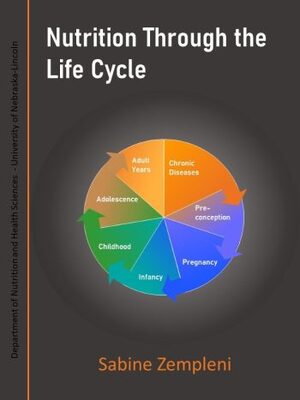
Nutrition Through the Life Cycle: An OER Created in Collaboration With Undergraduate Students
Sabine Zempleni
Quality of life and healthy life expectancy depend on avoiding or delaying chronic diseases. Lifestyle choices during all life stages, especially the critical periods, prime the individual for the development of chronic diseases.
This book is designed to accompany NUTR251 Nutrition Through the Life Cycle at the University of Nebraska-Lincoln.