

United States Department of Agriculture: Agricultural Research Service, Lincoln, Nebraska
United States Department of Agriculture-Agricultural Research Service / University of Nebraska-Lincoln: Faculty Publications
Accessibility Remediation
If you are unable to use this item in its current form due to accessibility barriers, you may request remediation through our remediation request form.
Document Type
Article
Date of this Version
1981
Citation
Desert Plants 3(4) Winter 1981-82
Abstract
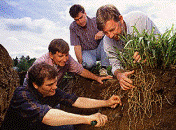
Four years ago, a young Mexican botanist made what may someday be recognized as the "botanical find of the century." Rafael Guzmán, a student at the University of Guadalajara, was searching for one of the wild relatives of corn in the mountains of southern Mexico. Guzmán was looking for Zea perennis, a perennial "teosinte" thought to be extinct in the wild since the early 1920's. This primitive corn relative was considered more of a botanical curiosity than a boon to mankind. As a tetraploid, perennial teosinte produces sterile offspring when crossed with corn, a diploid species. Guzmán found perennial teosinte growing in a remote mountain site.